

 Posted by
 Ever wondered how to prepare students for a world driven by technology, innovation, and constant change?
STEM education addresses the needs of a changing environment. Today, classrooms are no longer limited to textbooks. They go beyond traditional methods of learning.
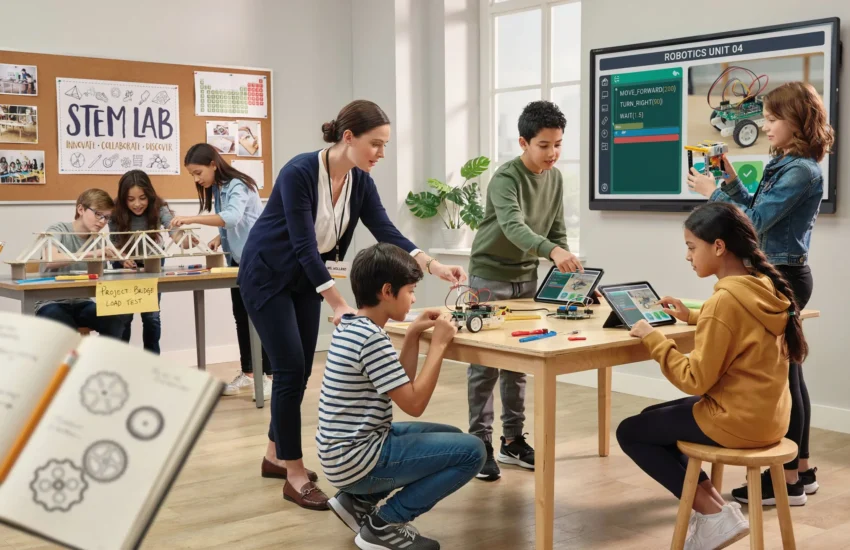
Education has become more technology-driven with innovations such as smart boards and new learning tools that help students develop the latest skills needed to succeed in their careers. It fosters creativity, communication with real applications, and practical experiences. This is what STEM education helps achieve.
Table of Contents:
- What is STEM Education
- Why is it important
- Key Components of STEM Educations
- Benefits of STEM Education
- How STEM Education Develops Future-Ready Skills
- Challenges
- Final Thoughts
What is STEM Education
STEM education is an interdisciplinary approach in which students learn subjects through hands-on activities, practical experiences, guidance, and real-life examples. It helps students create innovative ideas, build critical thinking, and enhance their creativity.
Students can combine theoretical knowledge and apply it across multiple disciplines through this learning approach. STEM education helps students apply principles in real-life situations by encouraging them to use what they learn in the classroom to solve problems. Instead of studying concepts through textbooks, students participate in hands-on projects, experiments, and design challenges that demonstrate how Modern tools are used in everyday life.
Motivating students to ask questions, find solutions, and work on projects, STEM education creates an interactive learning environment. Instead of memorizing concepts, students develop understanding by doing, and make learning enjoyable.
Why is it Important
The goal of this STEM education is to develop creativity, problem-solving skills, and the ability to prepare students for new Innovations and the modern workplace. Hence, schools and institutes must implement this approach to naturally inculcate these skills in students.
Once you have an understanding of the core elements, you can go into various business fields such as healthcare, robotics, information technology, scientific research, data science, applied sciences, and engineering.
As industries continue to grow and change with advanced tools, there is an increase in demand for individuals who know how to use and adapt to change and solve problems. STEM education equips students with these essential skills, helping them become confident learners and preparing them for successful careers in a rapidly changing world.
Key Components of STEM
STEM education combines traditional and integrated learning, bringing together four core subjects: Science, Technology, Engineering, and Mathematics. It emphasizes hands-on learning experiences, critical thinking, creativity, and problem-solving to prepare students for real-world problems.
The following are the core components of STEM education:
-
Science
Focuses on understanding the world through scientific research, observation, experimentation, and evidence-based analysis. Students learn to collect data, analyze results, draw conclusions, and develop critical thinking skills by using the scientific method.
-
Technology
It helps students stay updated with the latest tools, frameworks, and modern workflows. It enables them to learn digital skills, use emerging technologies effectively, and continuously upskill to meet the demands of today’s rapidly evolving world.
-
Engineering
Engineering focuses on designing and building solutions to real-world problems. Students apply scientific and mathematical concepts to create models, develop prototypes, test ideas, and refine their designs through an iterative process. This encourages creativity, innovation, teamwork, and problem-solving skills.
-
Mathematics
Mathematics is essential for logical reasoning, analytical thinking, and accurate decision-making. Students learn to solve problems using numbers, formulas, patterns, mathematical concepts, and data analysis. These skills provide a strong foundation for understanding science, developing engineering solutions, and working with technology across various fields.
Benefits of STEM Education
STEM education equips students with essential skills, helping them become confident learners and preparing them for everyday situations in a rapidly changing world.
Below are the common benefits of STEM education that support students’ academic growth.
- Better Critical Thinking: It enhances the ability to analyze and interpret information more clearly, helping individuals make better-informed decisions.
- Enhances Creativity: Encourages you to think of new ideas and innovative solutions. It helps you approach challenges from different perspectives.
- Collaboration with Team: Develops communication and teamwork skills through group activities. Learn from others as you work toward a common goal.
- Practical Knowledge: Connects theoretical concepts with practical real-world applications. Makes learning more meaningful and easier to apply in everyday situations.
- Creates Curiosity: Encourages you to ask questions and explore new ideas.
Builds a desire for continuous learning and discovery. - Problem-Solving Ability: Strengthens your ability to identify problems and find effective solutions.
Helps you think logically and make informed decisions. - Better Understanding of Concepts: Makes complex topics easier to understand through practical learning. Helps improve knowledge retention and long-term understanding.
How STEM Education Develops Future-Ready Skills
The future workplace is booming with technologies such as artificial intelligence, automation, data processing, analytics, and robotics transforming the way industries operate. STEM education prepares students for these changes by helping them develop skills that go beyond academics.
Through project-based learning and collaborative activities, students learn how to adapt to new situations and think critically. These experiences build confidence, resilience, and the ability to approach challenges with innovative solutions.
In addition to strengthening technical understanding, STEM education nurtures transferable skills that remain valuable across every profession. Students improve their communication, digital literacy, and decision-making abilities while learning to evaluate information and solve problems.
As industries continue to embrace emerging tools, these future-ready skills enable learners to stay competitive, pursue diverse career opportunities, and contribute meaningfully to an innovation-driven world.
Challenges in Implementing STEM Education
STEM education equips students with the knowledge and practical skills needed to solve real-world problems and prepare for the future. Despite its growing importance, implementing STEM education effectively presents several challenges.
- Lack of Resources: Many schools face difficulties in providing modern infrastructure, equipment, and learning materials required for effective education.
- Insufficient Training: Teachers may require additional training and support to effectively implement interdisciplinary and project-based learning methods.
- High Costs: Setting up STEM programs, purchasing equipment, and maintaining smart tools can be expensive for educational institutions.
- Curriculum Integration Challenges: Integrating STEM activities with existing academic curriculam can be difficult due to time constraints and traditional teaching methods.
- Limited Access to Technology: Unequal access to digital tools can create differences in learning opportunities among students.
- Difficulty in Assessment: Evaluating practical skills, creativity, and problem-solving abilities can be more challenging than traditional written assessments.
- Lack of Awareness and Support: Limited awareness among students, parents, and institutions about the importance of STEM education can affect its successful implementation.
Addressing these issues can make STEM education more accessible and effective. By investing in quality infrastructure, professional development, and innovative teaching practices, institutions can equip students with the skills and confidence they need to grow in life.
Final Thoughts
STEM education creates a strong connection between classroom learning and real-world problem-solving. By encouraging innovation, exploration, and practical application of knowledge, it helps students develop the abilities required to navigate future challenges. With the right support and resources, it can play a key role in shaping skilled, adaptable, and future-ready individuals.